
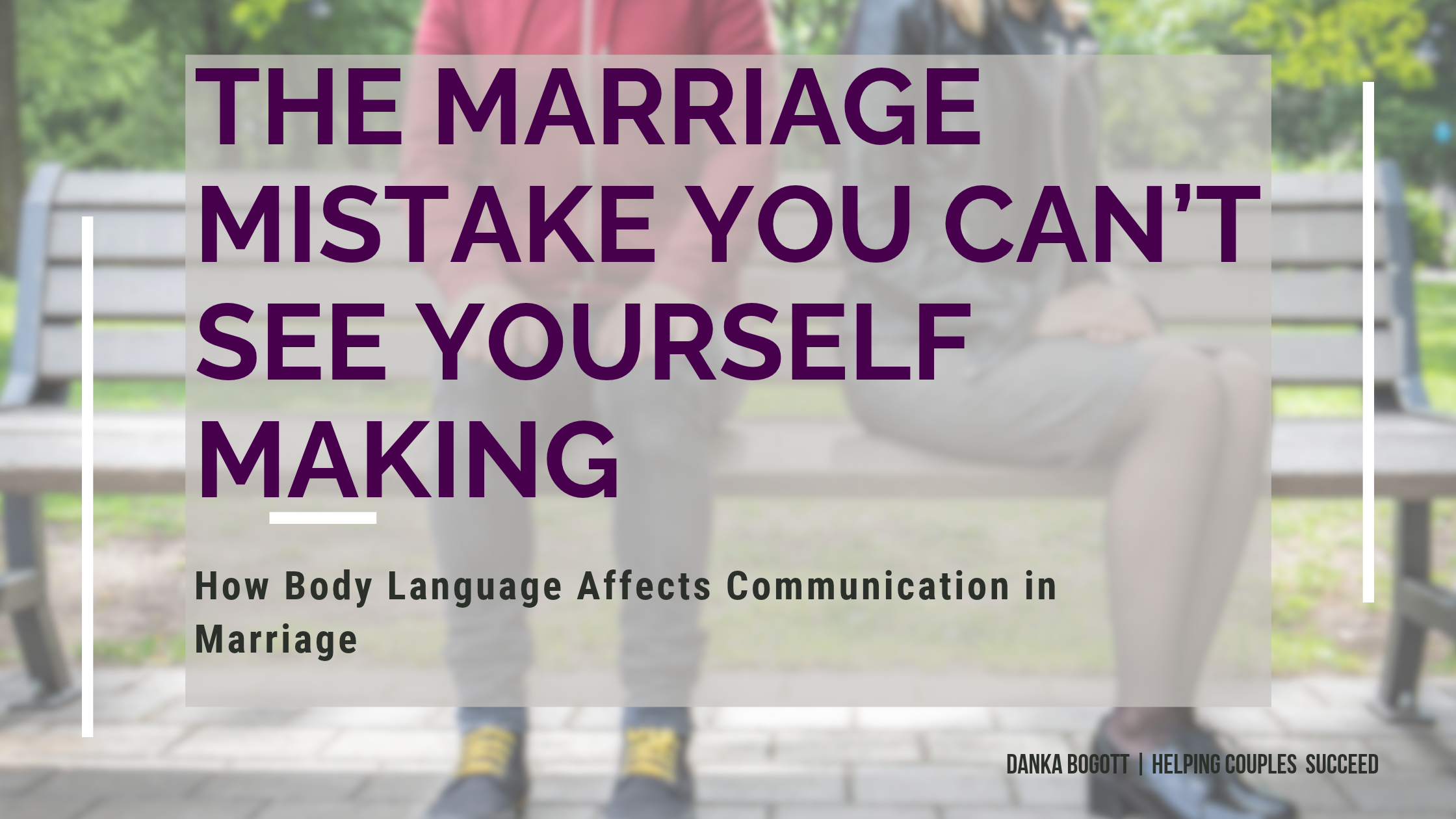
Have you ever tried to have a conversation with your spouse, and even though they’re saying all the right things, something about the way they’re saying them just doesn’t sit right with you?
Maybe they’re telling you they’re listening, but they’re looking at their phone.
Maybe they’re saying they’re not upset, but their arms are crossed, their face is telling a completely different story, and their tone of voice isn’t helping either.
Here’s something I want married couples to understand:
What you’re saying and how you’re saying it need to match.
Because when they don’t, your spouse may hear something very different from what you intended.
And sometimes, you may not even realize you’re doing it.
Here’s something I think married couples often forget.
There’s a gap between what we THINK we’re communicating and what our spouse is actually experiencing.
You might think you’re being perfectly reasonable. You might think you’re listening, that you’re open to the conversation, that you’re not doing anything particularly upsetting.
But your spouse might be experiencing something completely different.
And here’s why.
None of us walks around with a mirror constantly in front of our face, showing us what everybody else sees.
Think about that for a second.
You can’t see yourself rolling your eyes. You can’t see the expression on your face when your spouse brings up something you don’t particularly want to talk about. You might not even realize that your arms are crossed, that you’re fidgeting, or that you’re waving your spouse off with your hand.
But your spouse sees ALL of it.
And sometimes they’ve been seeing it for YEARS.
You are not on the receiving end of yourself. Your spouse is.
And that means your spouse may know something about how you communicate that you genuinely don’t know about yourself.
Not because you’re intentionally being difficult or dismissive.
But because nobody has ever held up that mirror for you.
And sometimes, that’s exactly what your spouse is trying to do when they point these things out.
So let’s talk about three areas I want you to start paying attention to.
Let’s start with the obvious ones.
You’re trying to have a conversation with your spouse, but you’re standing there with your arms crossed.
Or you’re rolling your eyes every time they bring something up.
Or you’re waving your hand at them as if to say, “Enough. Stop talking.”
Maybe you don’t intend to communicate that you’re unwilling to listen.
But is that how you’re coming across?
If you want your spouse to know that you’re open to hearing what they have to say, you need to consider whether your body is communicating that same message.
Ask yourself:
Do I look like someone who wants to have this conversation?
Because if your words are saying, “I’m listening,” but your body is saying, “I couldn’t care less,” which message do you think your spouse is going to notice?
Now let’s talk about tone of voice.
Because it’s not just what you say.
It’s HOW you say it.
Think about how differently the exact same sentence can sound depending on your tone.
You can say, “I’m really glad you told me,” with genuine warmth and appreciation.
Or you can say those exact same words in a tone that makes it perfectly clear you’re anything but glad.
Same words.
Completely different message.
Volume matters, too.
Are you getting louder? Are you sounding irritated? Are you speaking in a way that makes it difficult for your spouse to hear what you’re actually trying to communicate?
We understand this when we’re talking to our children.
If your two-year-old is upset and you’re trying to comfort them, you naturally change how you approach them.
You soften your voice. You change your posture. You might get down to their level and hold them.
Why?
Because you want what you’re communicating to actually reach them.
Why would we forget to do that with our spouses?
Here’s another one I see couples struggle with.
Your spouse wants to talk about something important.
And you’re sitting there holding your phone.
Maybe you’re not even looking at it.
Maybe the screen isn’t lighting up.
But you’re holding it, glancing at it, waiting for something to happen.
Or maybe you’re looking through your calendar while your spouse is talking.
What message might that send?
Your spouse may be thinking, “You don’t even want to be here having this conversation with me.”
Now, that may not be what you’re intending to communicate.
Maybe you’re distracted. Maybe you’re tired. Maybe you genuinely don’t have the energy to give this conversation the attention it deserves.
Then say that!
I’d much rather you tell your spouse:
“I really want to talk about this, but I don’t have the time or the energy right now to give this the attention it deserves. Can we find another time to sit down and talk about it?”
That’s a very different message from sitting there looking distracted while insisting you’re listening.
This is where I want you to remember something important.
Your spouse may genuinely not know what they’re doing.
Maybe they’ve always had that facial expression.
Maybe they’ve always talked with their hands in a particular way.
Maybe they’ve always fidgeted or looked away when they’re uncomfortable.
And nobody has ever helped them understand how that comes across.
So rather than assuming they’re intentionally dismissing you, tell them what you’re experiencing.
“When I’m trying to talk to you about something important and you’re looking at your phone, it makes me feel like you don’t want to have this conversation.”
Or:
“When I bring something up and you roll your eyes, it makes it really hard for me to continue.”
You’re giving them information they may not have about themselves.
And hopefully, they can do something with it.
Now let’s turn this around.
What if you’re the one whose spouse has pointed something out?
Maybe your husband has told you three times that you roll your eyes when he brings up a particular subject.
Or your wife keeps telling you that your tone makes it difficult for her to talk to you.
And your response is, “That’s just how I talk!”
Well, maybe it is.
But if your spouse keeps telling you that something you’re doing is making your conversations more difficult, wouldn’t it be worth paying attention?
We do this with our teenagers all the time.
We tell them, “When you speak to me in that tone of voice, it changes how your message comes across.”
We teach them to pay attention to their expressions, their volume, and how they’re presenting themselves.
We help them understand that how they communicate matters.
Why would we expect our children to learn these things while refusing to learn them ourselves?
Sometimes we need to put our egos aside long enough to recognize that there’s something we could be doing differently.
Not because our spouse is trying to change everything about us.
But because we want our conversations to go better.
There’s something else I want you to think about.
Before you approach your spouse with a difficult conversation, remember who you’re talking to.
Remember your relationship.
Remember your history together.
Remember why you love this person.
And remember why this conversation matters.
Terry Real talks about “remembering love,” and I’ve taken that idea into my own work with couples.
I want you to remember WHO you’re talking to.
This isn’t just some random person you need to win an argument against.
This is your husband. Your wife.
The person you’ve chosen to share your life with.
And hopefully, the reason you’re bringing something up in the first place is because you care about your marriage and you want things to be better.
So ask yourself:
How do I want this message to land?
What do I need to stop doing so that my spouse can actually hear me?
What could I change about how I’m approaching this conversation?
Because sometimes the problem isn’t necessarily what you’re trying to say.
It’s how you’re delivering it.
I often talk with couples about all the things we were never taught about marriage.
Nobody hands us a marriage manual when we get married.
We have to figure so much of this out ourselves.
And sometimes that means learning things about ourselves that we didn’t even know we needed to learn.
Maybe you need to become more aware of your facial expressions.
Maybe you need to pay attention to your tone.
Maybe you need to put your phone down.
Or maybe you need to listen when your spouse tells you that something you’re doing is making it harder for them to communicate with you.
You don’t have to get everything right all the time.
But you do need to be willing to learn.
Because if you want your spouse to hear what you’re saying, you need to pay attention to the message you’re sending before you’ve even finished speaking.
And if changing something as simple as your tone, your posture, or where you’re looking could help your conversations go better, wouldn’t that be worth doing?
If you keep having conversations that turn into arguments, or you feel like you’re constantly misunderstanding each other, I work with married couples to help them recognize what’s happening and learn to do things differently.
[Schedule Your Initial Phone Consultation]
For more resources, check out these other posts!
Why Couples Therapy Isn’t Just For When Things Go Wrong
Emotional Neglect in Marriage: 7 Signs and How to Fix It